
|


 |
 |
 |
 |
 |
The Hopes and Dreams Series Overview
Four dramatic historical novels
for
Beginning Readers
__________
Literacy Skills


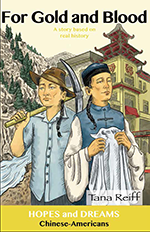

These four historical novels are:
- Easy to read
(Grade 1.5-2.5 reading level - for more information) - Hard to put down
- Vocabulary builders
- Structured reading practice for developing reading skills
- A powerful introduction to slices of American history
- A celebration of America’s diversity
- and most of all, engaging stories whose fascinating characters face prejudice, danger, hardships, and setbacks and survive with a little bit of luck and a generous amount of love.
The hopes and dreams of the characters in these four stories are a reflection of the hopes and dreams of virtually every group of people who have ventured from their homes to a new place for a new life in America. Each story and its characters reflect a part of the history of the United States. Yet at the same time each story is different, as the characters face challenges, defeats and victories in the fields and factories of Southern California, the gold fields of the West, the construction of the railroad in Utah, Chinatown in San Francisco, the Deep South and Southside Chicago, and New York’s Little Italy.
- Adult immigrants will have no difficulty identifying with people in the stories.
- Public School Children will feel history come alive
- Any struggling reader of Engligh will experience progress and enjoyment in reading successfully.
"It looks like poetry." This is what one person remarked as she opened the book and looked at a page. It is not intended to be poetry, but it intentionally breaks the normal rhythmic flow of English statements into phrases, chunks of words that naturally go together and should be seen, read, spoken, and understood as meaningful thought groups not broken up by the need to justify the lines.
These uninterrupted phrases also reflect a very basic feature of English grammar, the default phrase structure of noun phrase, verb phrase, and adverbials in that order. For example:
"Mama came in – noun phrase and verb phrase
from the fields." – adverbial (prepositional phrase)
In natural speech and in narration as well, there is a barely discernible pause between these two lines. This reflects the phonological as well as the grammatical structuring of English sentences, the subtle underpinnings of the language that students need to comprehend and use.
Another important aspect of this unbroken phrase approach is that each line, comprising one or two complete phrases, can be seen with one eye fixation, thereby contributing to easier and more fluent reading. Thus, the learner experiences success and, to put it simply, feels good about reading.
Vocabulary
The vocabulary level of the books is at the 300-600 level, meaning most of the words in the story can be comprehended by students with a vocabulary of more than 300 words. In Pro Lingua’s The Learner’s Lexicon, a learner at this level is described as being at the beginner proficiency level and functioning at a survival level.
Most of the words beyond the 600-level have been glossed in the back of the book, allowing readers to use the books more comfortably, without incessant reference to a dictionary.
Audio
The readers are also available with an audio component; in effect they can be used as an audio-book.
Teacher's Supplement
Available free online, the teacher's supplement includes the following:
- Brief plot summaries
- Discussion Questions for each chapter
- Historical photographs
- Detailed plot summaries
- Historical background
- Comprehension check: "What Did You Read" Form
- Book report form
- Word play activity
- Final Review Cloze activity
Mexican-Americans
Nobody Knows
African-Americans
For Gold and Blood
Chinese-Americans
Little Italy
Italian Americans
|
If you would like to visit us or for courier
and freight deliveries, our offices are at: |